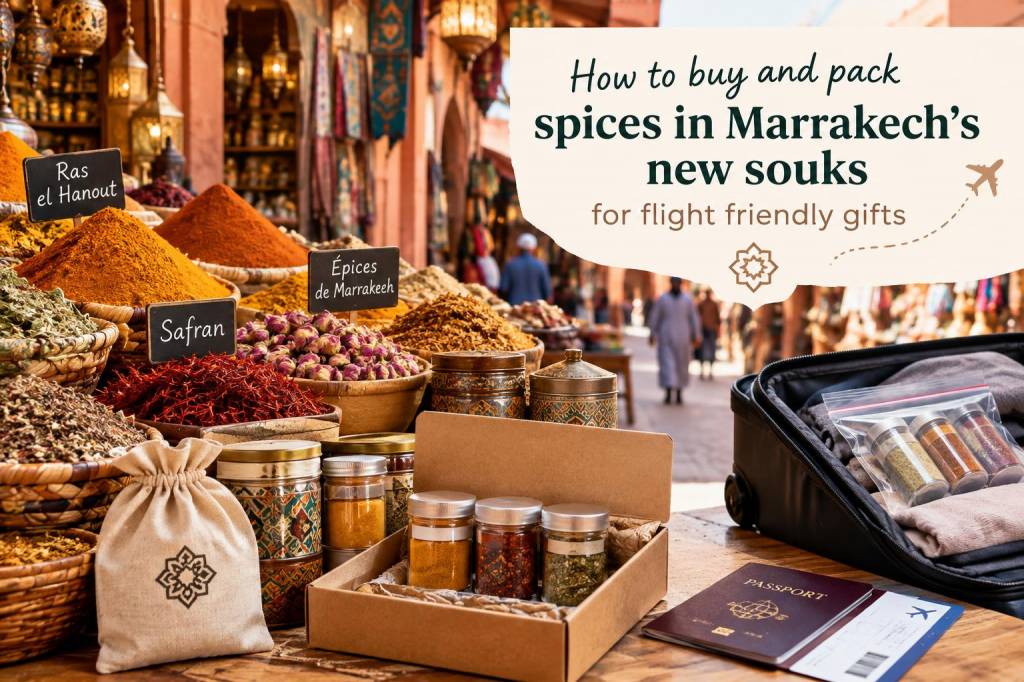
I roam souks the way other people collect postcards: by scent. In Marrakech’s new souks — those cleaner, brighter alleyways that sit alongside the older market lanes — the spice stalls are less chaotic than their historic cousins but full of the same intoxicating aromas. Over the years I’ve learned how to choose spices that travel well, how to spot good quality (and avoid tourist traps), and how to pack them so they arrive at home intact and airport-friendly. Below I share the practical steps I use every time I shop for spices in Marrakech, so you can bring back gifts that smell like the medina, not like spill clean-up.
Where to buy in the new souks — what to look for
In the newer sections of the souk you’ll find stalls that present spices in neat, stacked cones or sealed retail pouches. I prefer these stalls for two reasons: the display is often more honest (you can see and smell the product), and vendors are used to exporting small quantities for travelers.
When you approach a stall, I recommend asking the vendor to open a jar and let you smell. Good spices will be aromatic and clean-smelling — high-quality saffron smells floral and slightly honeyed, cumin is earthy and warm, while overripened or old spice smells flat or musty. If a vendor refuses to let you smell or tastes overly pushy, move on. The souk has plenty of honest traders.
Spotting authentic saffron and ras el hanout
Saffron is the one that provokes the most anxiety. Its price makes it a classic target for adulteration, but you can learn a few quick checks:
Ras el hanout varies wildly from maker to maker, and every family has its own recipe. If you like a vendor’s mix, ask for a written list of ingredients or watch them blend it. Avoid mixes that are very cheap and very bright in color — those often contain artificial colorants or excessive fillers.
Packing strategies for flight-friendly gifts
My priority is: keep spices dry, prevent crushing, and make security checks painless. Here’s my go-to packing workflow.
Choose the right packaging at the souk
If the vendor sells spices in sealed, retail printed pouches, buy those. They’re often vacuum-sealed or heat-sealed and carry labels — ideal for customs.
Double-seal powders and blends
For ground spices, request that the vendor seal them in a secondary plastic bag or a small Stasher-style silicone bag. I then add a layer of heat-sealed food-grade plastic using a simple iron-and-folded-paper trick: place the open end of the bag on a folded piece of baking paper and run the flat iron across it briefly to create a seal. It’s quick, cheap and effective.
Use cushioning and absorbents
Wrap glass jars in thin bubble wrap or a few layers of paper. Put a small silica gel packet inside the outer bag if you have one — it prevents moisture from compromising the aroma. If you’re packing several jars, nestle them in the middle of your suitcase among clothes to provide shock absorption.
Carry-on vs checked baggage — what I choose
I usually keep powdered spices in my carry-on for two reasons: they’re less likely to be crushed, and I can produce them easily at security if asked. However, there are a few caveats:
When I carry spices on board, I place them in an outer pocket for quick access. If a TSA or EU officer wants to test a sample, I can open one sealed pouch without upsetting my whole pack.
Labeling, receipts and customs
I always keep the vendor receipt inside the package or a photo of the merchant’s stall and label the spices with a simple note: “Dried culinary spices — not plant material or seeds for planting.” This has helped me through casual queries. Different countries have different rules: some allow dried spices without declaration, others ask you to declare any food items. A few points to remember:
Best small containers and brands I use
For ease and longevity I often repackage into tried-and-tested travel containers:
A few thoughtful spice gift ideas
Instead of giving random jars, I prefer to assemble a small “taste of Marrakech” kit:
These little kits feel personal and are easy to pack — they’re also the kind of gift that inspires friends to cook, which is the best souvenir in my book.