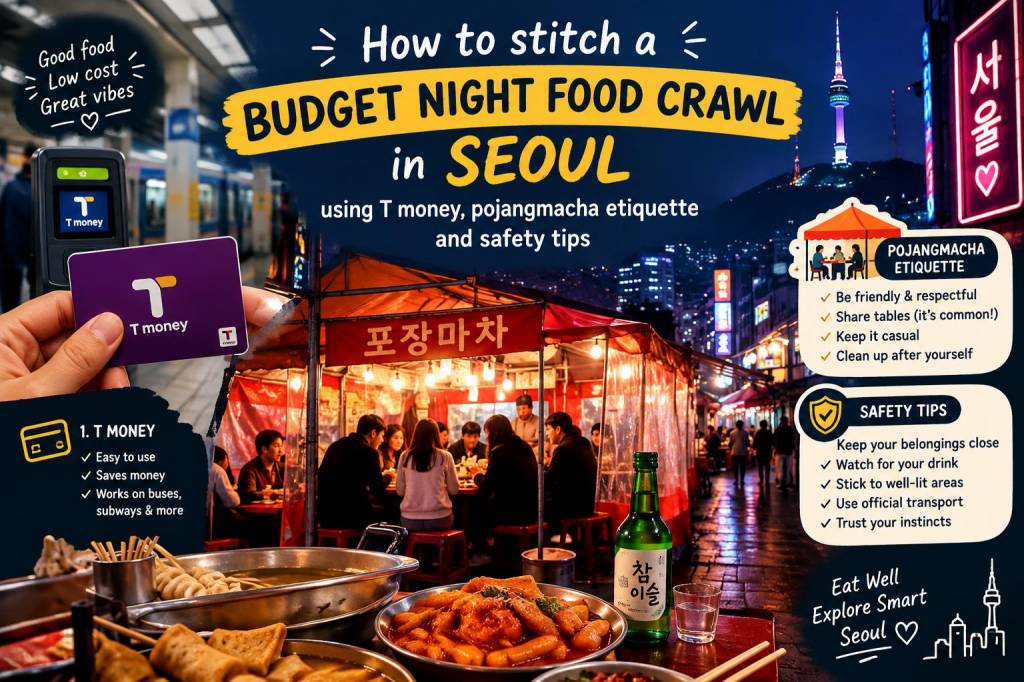
I arrive in Seoul most evenings hungry and deliberate, armed with a compact camera, a T-money card tucked in my wallet, and the same question: how far can I push a small budget while still tasting the city? Over the years I’ve stitched together countless night-food crawls — short, smart routes that let you sample the soul of Seoul without breaking the bank. Below I’ll share my methods, pocket-friendly itineraries, and the small etiquette and safety tips that keep those alleyway feasts memorable for all the right reasons.
Why night-food crawling in Seoul is special
Seoul after dark is a different rhythm: neon reflections on wet asphalt, markets that hum, and pojangmacha (street-tent stalls) where neighbors and late-shift workers mingle over steaming bowls. Night crawling is economical because portions are shareable, prices are low, and public transport keeps you mobile. For a local-feel experience, avoid glossy food courts and follow aromas, queues and the chatter of locals.
What you need to start: essentials and budget
Bring these three things on every crawl:
Here’s a simple cost breakdown I use when planning 3–4 stops:
| Item | Typical price (KRW) |
|---|---|
| Street skewers / eomuk (fish cake) | 1,000–3,000 |
| Dduk-bokki or noodle bowl | 3,000–6,000 |
| Soju or beer (shared) | 2,000–6,000 |
| Transit hops (T-money, 3–4 rides) | 1,350–3,000 total |
Reading the scene: where to go and how to pick spots
I favor neighborhoods that keep late hours: Hongdae, Jongno, Gwangjang Market, and the alleys around Sindang-dong. When scouting, look for:
My go-to crawl is compact and flexible: start with a market snack, move to a pojangmacha for a shared main, then finish with a late-night dessert or fried morsel. This keeps costs down and makes for forgiving pacing if you want to linger.
Sample 3-stop crawl (easy on the wallet)
Here’s a route I’ve repeated and refined. It’s designed around subway access and T-money convenience.
Total expected spend: 12,000–25,000 KRW depending on drinks and portions. Use your T-money card to hop between stations — swiping is faster than buying single tickets.
Pojangmacha etiquette (what locals expect)
Pojangmacha feel intimate. Treat them as shared living rooms rather than tourist spectacles:
Safety and comfort tips for late-night crawls
Seoul is generally safe, but I keep a few habits whenever I roam after dark:
Photography tips for street-food nights
I shoot these crawls with a compact mirrorless and minimal gear. For better photos without disturbing the scene:
When language gets in the way
Basic phrases are enough to navigate most stalls: “One order, please” (il eomjjeum juseyo), “Thank you” (gamsahamnida), and “Is it spicy?” (maepayo?). I also keep a translation phrasebook on my phone and use restaurant photos to point at dishes. Often, gestures and a shared smile bridge the gap better than perfect grammar.
Final practical notes
Night-food crawling is as much about the social rhythm as it is the food. Move slowly, be curious, and let the city decide the order of your stops sometimes — a sudden queue or a street musician can change the whole mood. Keep your T-money topped up, carry small bills, and respect the informal etiquette of pojangmacha. If you do, you’ll leave with a full stomach, a handful of photos, and the sort of small stories that make cities feel like home.