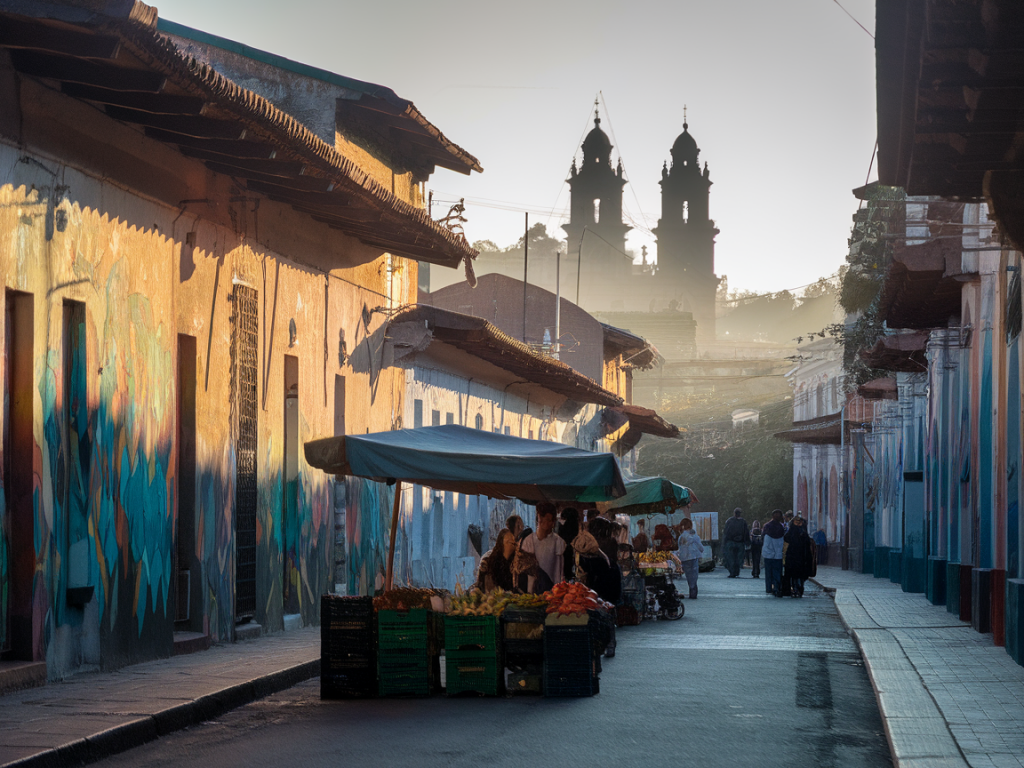
I arrive before the city wakes. In Bogotá the light at dawn has a cool, clean edge — the kind that pulls color out of brick and makes wet cobbles reflect neon signs like tiny mirrors. For a three‑hour photo walk through La Candelaria, I plan a tight route that catches murals, early market stalls and the slow bloom of morning from intimate alleys to wide plazas. The aim isn’t to rush through every postcard — it’s to linger where the light and life meet.
When to go and how to get there
In Bogotá, "dawn" is when the city still feels private. Depending on the time of year, golden hour here can begin as early as 5:15 or as late as 6:30 — check sunrise for your dates. I aim to start 20–30 minutes before sunrise so I can set up on a quiet corner and watch the light move across facades.
La Candelaria is compact and best accessed on foot once you arrive. Early in the morning TransMilenio service may be limited, so I usually grab an Uber or a licensed taxi to the Museo del Oro or Parque Santander. If you use public transport, get off at Museo del Oro and walk into the historic grid.
Gear and practical packing checklist
I prefer a compact mirrorless camera for these walks — light, unobtrusive and fast. Here’s what I bring:
| Camera | Mirrorless body (Fujifilm, Sony, Canon R, etc.) |
| Lenses | 24–70mm zoom or a 28–35mm prime + 50mm for portraits |
| Accessories | Spare battery, small SD card, wrist strap, lightweight camera bag |
| Clothing | Layers, light waterproof jacket, comfortable shoes |
| Extras | Small notebook, change for street food, phone with offline map |
Don’t lug a tripod unless you love waking up shoulders for long exposures — most dawn light is bright enough for handheld. Keep gear minimal and pockets secure: a small sling bag or crossbody that sits in front is my go‑to for safety and speed.
Safety and respectful shooting
La Candelaria is lively but still an urban neighborhood with pickpockets and busy streets. My rules:
The three‑hour route (timed plan)
This is the route I follow most mornings. It’s flexible — absorb the rhythm and linger where you find stories.
Arrive before sunrise and walk the wide stretches along Carrera 7 and the museum facade. This plaza gives you space to frame broad city light, capture street vendors packing up, and photograph the contrast between colonial architecture and the waking city. Wide angle (24–35mm) works well here.
Head down to Plaza de Bolívar while the light is still soft. Monuments cast long shadows and the early vendors set up near the steps. Move into the side streets toward Calle 11 and Calle 12 to catch early morning market carts and the first murals that catch the day’s light. A 50mm or 35mm is perfect for candid portraits of vendors making arepas or selling tamales.
One of my favorite pockets for texture and color is the Chorro de Quevedo area. The alleys here are saturated with murals, small cafés and artists’ studios. Work the alleyways slowly: shoot the details (peeling paint, wet cobbles), then step back for environmental portraits. If a café opens for breakfast, the steam from coffee against mural surfaces makes a great frame.
Walking south along Carrera 3 and 4 reveals large format murals and political art. This is a good time to change framing — try low angles to include sky and buildings for a sense of scale, or focus tight on brushstrokes, stickers and pasted posters.
Markets start to hum now. I look for fruit sellers, arepa makers and bread vendors. Shoot hands at work: slicing fruit, flipping arepas, and customers trading friendly banter. Ask before photographing people close up. Food stalls are also a great place to sample a calentao or a hot chocolate to warm up.
End at a small rooftop, staircase or sloped street where the sun now brushes the west‑facing facades. I like to find a spot near a café with an open terrace or up a pedestrian staircase to get a bird’s eye view of the neighborhood waking up. This is where you pull together wide urban frames that include murals, plazas and the geometry of La Candelaria streets.
Shooting approach and creative tips
Where to refuel after the walk
By the time my walk ends I’m ready for real coffee and something warm. I head to a small local café — many in La Candelaria open mid‑morning — and order tinto and a calentao or tamal. Sitting outside, I scroll through images and make quick notes on what worked and what I want to try next time.
Dawn in La Candelaria rewards patience. If you go slow, you’ll find quiet murals, candid market moments and a light that reveals the neighborhood’s textures. Bring layers, travel light and stay curious — the best images often arrive when you stop planning frames and just follow a sound, a face or a color down an alley.