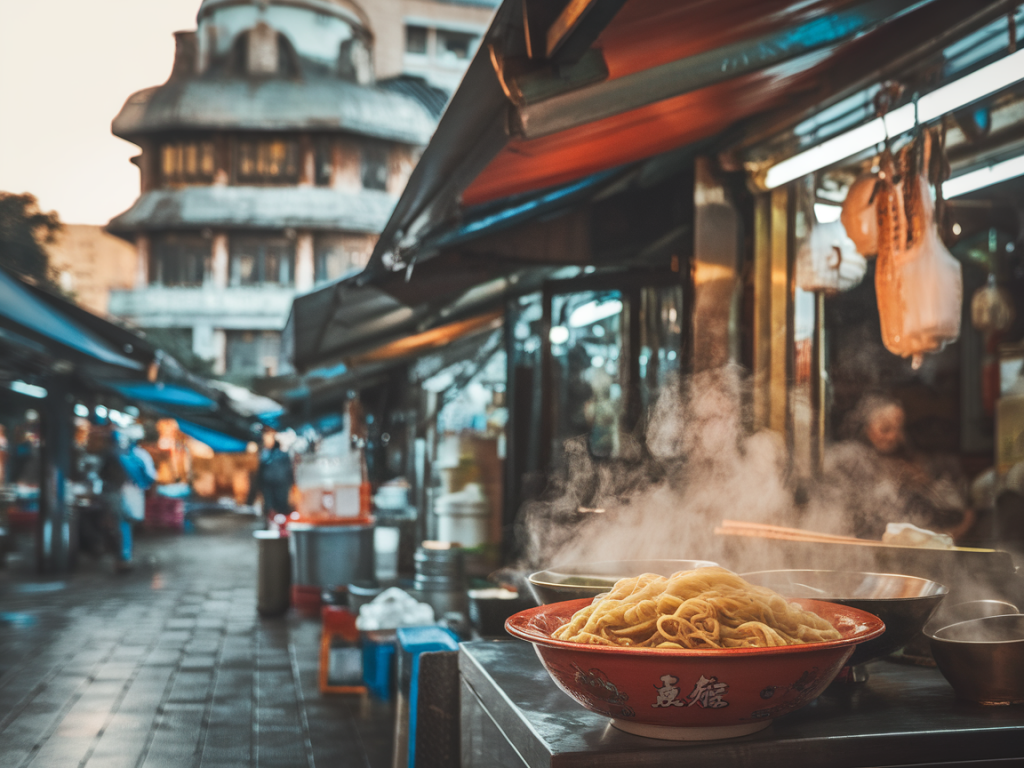
The sky over Taipei was still a bruise when I stepped onto Dihua Street. Dampness hung in the air like a promise — that particular mix of river fog, early-morning rain and the leftover steam from noodle pots that makes this market come alive in pictures. I had exactly 90 minutes to move through the market, find a handful of scenes that told its story, and come away with frames that felt tactile: wet cobblestones, glistening tarps, vendors’ hands shaped by decades of service, and noodles pulled into threads of steam.
Why 90 minutes?
Ninety minutes is long enough to build rhythm and short enough to keep energy high. At dawn the market changes fast: stalls open, the light shifts from blue-hour cool to warm streetlamps, and the density of people surges. In one and a half hours you can trace a clear narrative — waking streets, food prep, first customers — without losing the quiet intimacy that makes dawn photos special.
My essential gear
I travel light. For this shoot I used my compact mirrorless (a Fujifilm X-series body) with two lenses clipped to my strap: a 23mm f/2 (roughly 35mm equivalent) and a 35mm f/1.4 (50mm equivalent). These give me versatility for both context shots and close portraits. I also had:
I keep filters minimal — no polarizing filter at dawn. I shoot raw and accept that post will recover shadows and color cast from mixed light sources.
Timing and route
Arrive 15 minutes before your intended start to orient yourself. I begin at the north end of Dihua Street, near Dihua Street Park, and walk south toward Anping Street, pausing at five priorities:
Walk slowly and pause every 3–5 minutes to make a deliberate frame. The whole loop takes about 90 minutes if you allow for intentional slow shooting and short conversations.
What to capture — story beats
I think in beats: an opening, a texture interlude, a human detail, and a closing frame.
Camera settings and light handling
Dawn in Dihua is hybrid light — blue hour mixed with warm street bulbs and inside shop fluorescents. I use the following as a starting point:
When steam is the star, underexpose slightly to keep highlights from blowing out. Steam photographs best against darker backgrounds; move to position your subject in front of deep tones — a shuttered signboard, a wet awning.
Interaction and etiquette
Markets are working places. I balance curiosity with courtesy:
Composing for wetness and steam
Wet surfaces and steam are visual amplifiers. I look for contrast:
Short post-processing checklist
| Step | Purpose |
| Crop and straighten | Clean up composition; emphasize reflections or leading lines |
| Exposure and contrast | Recover shadow detail; keep highlights of steam controlled |
| White balance | Adjust to taste — retain warmth for human feel |
| Clarity and texture | Increase slightly on hands and food; avoid overdoing steam |
| Noise reduction | Apply selectively, preserving detail in texture areas |
On my last pass through Dihua I left with thirty usable frames and two that felt like stories: a vendor ladling broth over rhythmic slurps of noodles, and a low, reflective shot of a single lantern mirrored in a puddle with a vendor’s boots at the edge. Both were shot within the first hour, proving that planning beats waiting for perfection.
If you go, bring a sense of patience and a willingness to be present. The market yields to those who pay attention — to the sound of boiling water, the flash of steam, and the small, steady rituals of morning vendors. Ninety minutes can be enough to come away with images that smell of broth and rain; the rest you’ll bring back with you in memory.