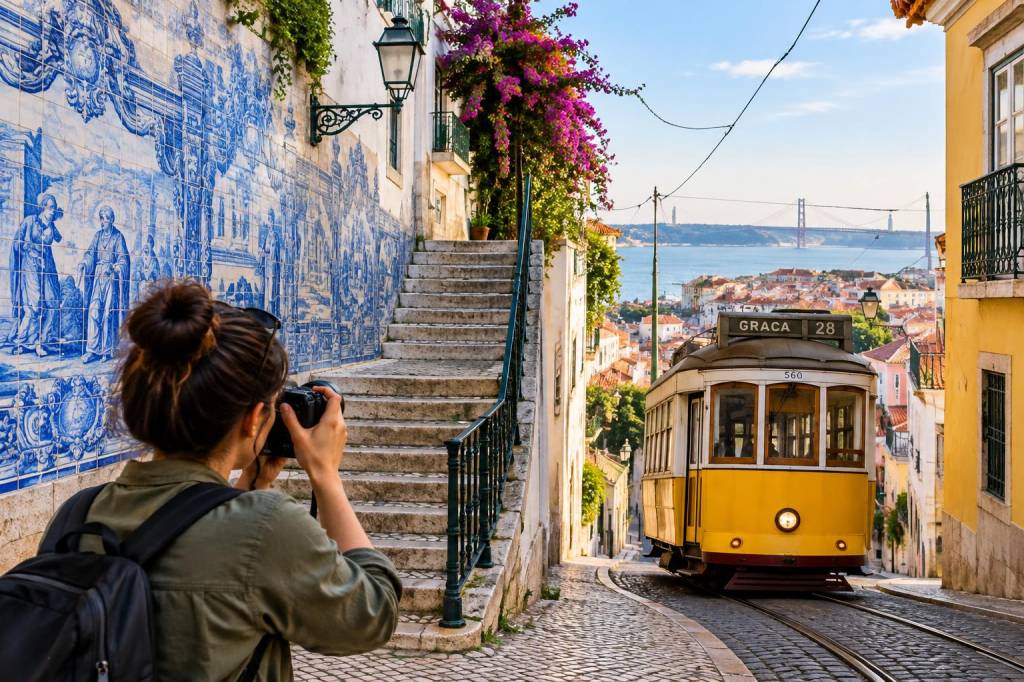
I like Lisbon for the same reason I like photographing it: every street seems to hold a small, textured surprise, and it never asks me to rush. On a good day, I can spend hours moving through one neighborhood, stopping for stairways lined with painted tiles, tram stops wrapped in old-world character, and the kind of light that makes yellow walls glow just before noon. When I plan a photo loop in Lisbon, I do not chase a long list of famous landmarks. I choose one compact area, walk slowly, and let the city reveal a rhythm that feels both lived-in and visually rich.
For azulejo stairways and tram stops, I usually work within a neighborhood that has a dense mix of residential streets, steep climbs, and transit lines. Alfama, Graça, and parts of Estrela or Campo de Ourique can all work, depending on what mood I want. I prefer a loop that keeps me close to public transport, because it gives me freedom to start early, pause for coffee, and still avoid feeling like I am covering too much ground. My goal is not speed. It is to photograph a handful of scenes well, while staying present enough to notice details like chipped paint, laundry lines, and the reflection of a tram cable in a shop window.
Choosing one compact area with visual variety
Before I leave my accommodation, I sketch a loop with three ingredients: a stairway with decorative tiles, one or two tram stops or tram-adjacent corners, and a few side streets that offer texture without heavy traffic. A neighborhood loop works best when it has vertical movement, because stairs naturally create layers in a frame. In Lisbon, azulejo stairways often sit in residential pockets where balconies, doors, and worn handrails add context. That context matters to me. I do not want a stairway that looks isolated from the city. I want one that feels embedded in daily life.
If you are building your own loop, start by mapping a cluster of places rather than a line. I look for a stairway near a tram route, then add nearby alleys, viewpoints, and a café stop. A compact cluster keeps me from backtracking too much, which is useful when I am carrying a camera and waiting for certain light. It also helps me avoid the common mistake of trying to photograph too many neighborhoods in one morning. Lisbon rewards focus.
When I start and why timing changes everything
I usually begin early, ideally soon after sunrise, because Lisbon’s streets can feel calmer and cleaner in the first hours of daylight. Tile surfaces look different in soft light. Colors are less harsh, shadows are longer, and tram stops are often quieter before commuter traffic builds. That quieter atmosphere changes the way I shoot. I can step back, wait for a single person to enter the frame, and let the composition breathe.
Later in the day, I still find good moments, but I adjust my expectations. Midday can flatten colors and create strong contrast on white walls, while late afternoon can bring beautiful warmth and also more foot traffic. If I know I want a tram stop shot with a cleaner background, I try to arrive before the rush. If I want motion and layered street life, I may return when the area is busier. I like that flexibility. It lets me photograph the same place in two very different moods without leaving the neighborhood.
What I look for in azulejo stairways
My favorite stairway images are rarely symmetrical perfection. I am drawn to the small irregularities that make the scene feel real. I look for tile patterns that repeat but do not feel sterile, for worn edges that catch the light, and for staircases that curve or turn enough to hide part of the story. A stairway with a landing can give me a stronger composition than a straight flight, because the break in the line adds pacing. It also lets me include a door, a lamp, or a potted plant as a visual anchor.
I often shoot from a lower angle to emphasize height and make the stairs feel more dramatic. Other times I step back and let the full staircase sit inside its neighborhood setting. That wider view is useful when the tiles are only one part of the story and the surrounding buildings matter just as much. I also pay attention to color relationships. Blue and white tiles are the obvious draw, but they become stronger when paired with rust, pale yellow, mint green, or the faded red of a doorway.
One thing I never forget is to keep my frame clean. Lisbon stairways can be beautiful, but they can also get visually crowded with parked scooters, bins, cables, or signage. Rather than complain about those elements, I treat them as part of the scene and decide whether they help or hurt the frame. Sometimes a single cable line across the image gives the photo urban tension. Sometimes it is distracting, and I wait for a better angle.
How I photograph tram stops without turning them into snapshots
Tram stops are easy to photograph badly because they tempt you to shoot too quickly. I slow down and treat them as mini street scenes. I look for the relationship between the stop, the tracks, the surrounding architecture, and the people waiting. A good tram stop photo in Lisbon often needs one clear subject: a person leaning against the shelter, a tram arriving in the distance, or the curve of the wires overhead. Without that anchor, the image can feel flat.
I also like to include movement. I wait for a tram to pass, for someone to cross the street, or for a breeze to lift a skirt or coat. Those small moments give the frame life. If I am using a phone, I will sometimes hold still and make several shots as the scene evolves. If I am carrying my compact mirrorless camera, I keep a moderate focal length ready so I can move quickly without overthinking it. A versatile lens is enough. I do not need a heavy setup to make the scene feel cinematic.
What matters most is patience. I might stand near a stop for ten minutes and only press the shutter twice. That is normal for me. I would rather have two images with intention than twenty that repeat the same idea. And if a tram stop is busy, I embrace that energy instead of trying to remove it. Lisbon transit is part of the city’s character, and the waiting itself often becomes the visual story.
My pace for a single neighborhood loop
When I design a loop, I keep it loose enough to allow detours. A good walk might take me two to four hours depending on how many times I stop. I usually plan for a café break halfway through, because sitting down helps me review what I have already shot and notice what still feels missing. If I have been focusing on stairways, I may realize I still need one wider street scene to balance the set. If I have been shooting transport details, I may decide I want a portrait of the neighborhood itself, with washing lines or tiled façades as a backdrop.
I think in layers rather than checklists. First layer: arrival and orientation. Second layer: the main staircase. Third layer: tram stop and surrounding streets. Fourth layer: a quieter side alley, maybe with a doorway or sign that adds character. That sequence keeps me from drifting aimlessly, but it also leaves room for surprise. Sometimes the best frame appears between planned stops, in a place I would have ignored if I had been moving too fast.
Here is the practical rhythm I often use on a loop like this:
- Start early and walk slowly toward the first stairway.
- Photograph the staircase from both a wide angle and a tighter detail view.
- Pause near a tram stop and wait for movement, not just architecture.
- Take a short break for coffee or water before the light shifts too hard.
- Finish with one or two quiet streets that give the neighborhood a human scale.
Small decisions that make the photos feel more alive
I pay attention to shoes, bags, and comfort because a Lisbon loop usually includes steep climbs and uneven pavement. If I am uncomfortable, I stop noticing details. I also carry a microfiber cloth for lens smudges, a battery pack, and enough water to avoid making hurried choices later. Those are not glamorous items, but they keep me patient, and patience is what makes the loop work.
For exposure, I often protect highlights because Lisbon walls, tile surfaces, and bright sky can blow out quickly. I would rather deepen shadows a little than lose the texture in a white façade or a glazed tile panel. In post-processing, I keep colors natural. I want the blues of the azulejos to stay rich, but I do not want the city to look overprocessed. I am always trying to preserve the feeling I had on the street: calm, curious, and slightly slowed down.
If I am photographing people near tram stops, I try to be respectful and discreet. I do not block the platform, and I avoid intrusive close-ups unless I have clear permission. Often the strongest image is not a face at all, but a silhouette, a hand on a rail, or a figure waiting in profile beside a tiled wall. That approach lets me tell a human story while keeping the scene honest.
| Moment | What I look for | Photo approach |
|---|---|---|
| Early morning | Soft light, quiet streets, empty stairs | Wide frame, gentle shadows, strong geometry |
| Mid-morning | More street life, active tram stops | Layered composition, waiting figures, motion |
| Late afternoon | Warm tones, longer shadows, busier sidewalks | Backlight, reflections, moodier street scenes |
Places where I slow down and stay longer
Some spots ask for more time than others. A stairway with a beautiful tile panel may deserve repeated attempts from different angles. A tram stop with an elegant shelter might change completely when a tram arrives, then again when the crowd thins. I stay longer when the scene feels layered, because I know the final image often comes after the first obvious shot. That is especially true in Lisbon, where a place can look simple at first and reveal depth once I notice the smaller elements around it.
What keeps me interested is not only the architecture but the pulse of everyday use. A staircase is not just an object to photograph; it is a route people use to get home, to shop, to visit neighbors, to carry groceries. A tram stop is not just a pretty transit point; it is a place where waiting becomes part of city life. When I keep that in mind, my photos feel less like souvenirs and more like records of movement, habit, and atmosphere.