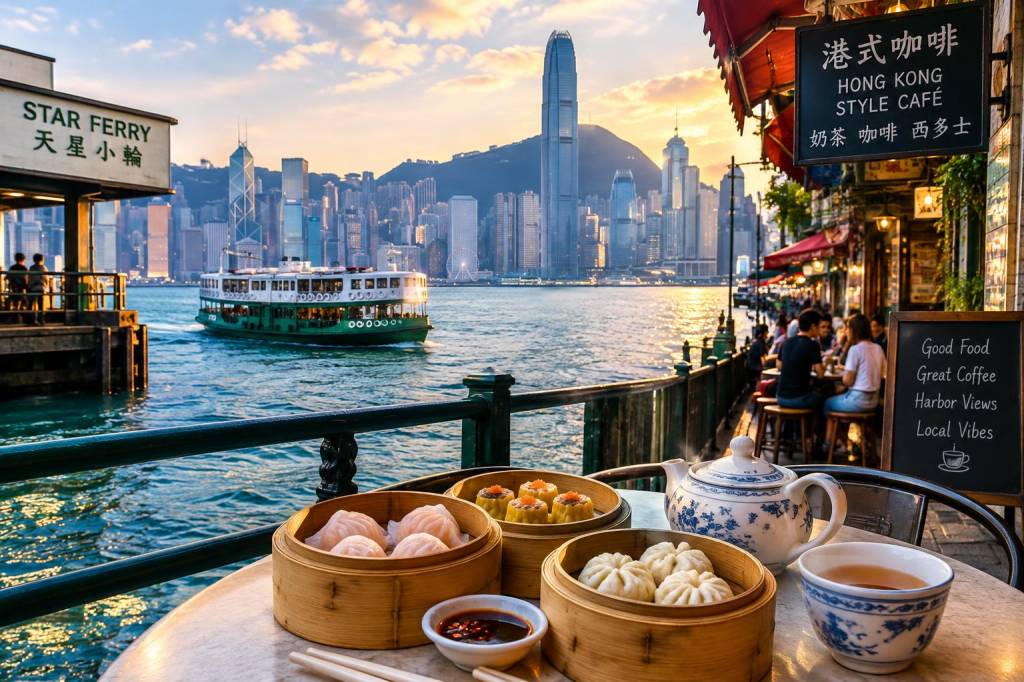
I keep returning to Hong Kong for the same reason: it lets me stitch together two very different moods in a single day. One moment I am standing beside a ferry pier with wind in my face and container ships sliding past a glittering harbor. A few streets later I am sitting in a backstreet café, balancing a plate of dim sum while office workers, retirees, delivery riders, and students drift in and out around me. That contrast is what gives the city its pulse. If you want harbor views, real neighborhood texture, and a sense of local rhythm, I always start with the waterfront and then move inland on foot.
What makes Hong Kong so satisfying for slow urban wandering is that the city keeps rewarding small detours. A pier is never only a place to board a boat. It is often a viewing platform, a commuter crossroads, and a quiet place to watch the light change across Victoria Harbour. Likewise, a café tucked in a side street is rarely only about coffee. It can be where I find sesame buns still warm from the oven, silky milk tea, or a single table where regulars read newspapers and argue softly over breakfast. Those are the moments I travel for.
Where I go for harbor views that feel alive
When I want a classic harbor moment without feeling trapped in a tourist crowd, I head to the ferry piers rather than chasing a postcard viewpoint. Ferry piers are active, practical, and surprisingly scenic. There is movement, salt air, and a steady rhythm of arrivals and departures that makes the waterfront feel lived in rather than staged. I like that energy. It reminds me that Hong Kong is a working port city first, a skyline destination second.
Central Ferry Piers are where I usually begin. From the waterfront promenade near the piers, I can watch boats cut across the water while towers reflect on the harbor surface. The area feels especially rewarding in the early morning, before the heat builds and before the pace of the day fully wakes up. I often grab a takeaway coffee, lean on the railing, and watch the city turn from silver to gold. In the evening, when the lights come on, the same place feels almost theatrical.
From Central, I often take a ferry to Tsim Sha Tsui or simply linger around the piers and nearby walkways. If I have more time, I use the ferry not just as transport but as a slow-moving observation deck. Even a short crossing gives a fresh view of the skyline, and it is one of the most affordable pleasures in the city. I always tell myself that a ferry ride is not a compromise compared with a private harbor cruise. For me, it is better, because it feels like part of everyday Hong Kong life.
Another spot I like is the area around North Point Ferry Pier. It is less polished, less obvious, and more textured. I enjoy that slightly rougher edge. Street noise mixes with harbor air, and the surrounding neighborhood gives the waterfront a stronger local identity. If Central is the city in its business suit, North Point is the same city after work, sleeves rolled up, buying dinner ingredients on the way home.
Backstreet cafés where breakfast becomes a city lesson
Some of my best Hong Kong memories happened far from the waterfront, in narrow streets where cafés and tea shops sit behind laundry racks, small supermarkets, and old apartment blocks. These places are often easy to miss if you are moving quickly. I slow down in districts like Sheung Wan, Wan Chai, Mong Kok, and Sham Shui Po, because that is where I find the city’s daily food rituals in their most honest form.
In Hong Kong, a café can mean many things, but I usually look for a cha chaan teng or a humble local eatery where breakfast and lunch blur together. I love ordering simple combinations that reveal the city’s culinary grammar: macaroni soup, pineapple bun with butter, scrambled eggs over toast, and a cup of strong milk tea. These are not elaborate dishes, but they are deeply satisfying. They taste like the city works: efficient, comforting, and a little intense.
One reason I enjoy these places is that they reward observation. I watch how people order, how fast the staff move, which tables are treated like regular territory, and which dishes disappear first from nearby trays. There is a social choreography to these cafés. If you pay attention, you start to understand how locals structure their mornings. People do not come only to eat. They come to reset before work, to read the paper, to meet someone for ten minutes, or to enjoy one hot meal before a long day.
I also love cafés that feel slightly tucked away from the main streets. In Hong Kong, the best rhythm often sits one block behind the obvious route. I have found memorable spots by following the scent of toasted bread, the clatter of plates, or a line of people waiting under a faded sign. Those places usually do not advertise much. They do not need to. Regulars keep them alive.
Dim sum stops that fit a wandering day
If I am planning a day built around harbor views and neighborhood walks, I want dim sum somewhere in the middle. It does not have to be a grand banquet. Sometimes I want a quick, efficient spread that lets me keep moving afterward. Other times I want to sit longer, order more tea, and let the meal slow the whole day down. Hong Kong gives me both.
I usually look for places that balance tradition with neighborhood life. The setting matters to me as much as the food. A dining room with chipped tile, steam fogging the windows, and a steady stream of trays passing by can feel more memorable than a polished venue. I especially like arriving slightly off-peak, when the room is still lively but not overwhelming. That is when I can settle in and notice details: the shine of the metal trolleys, the scent of chrysanthemum tea, the sound of chopsticks tapping ceramic plates.
My favorite dim sum sequence tends to include shrimp dumplings, siu mai, turnip cake, rice noodle rolls, and custard buns if I want something sweet at the end. I do not rush through them. I like pairing each bite with a pause, then stepping back into the street to let the food settle while I keep walking. In Hong Kong, that rhythm feels natural: eat, walk, observe, eat again.
Neighborhoods I use for a harbor-and-café route
When readers ask me where to spend a day that combines waterfront views and local food, I usually recommend building a loose route rather than chasing one famous landmark. The city works better that way. You can move from pier to side street, then from tea shop to market lane, and the pieces start to connect.
Here is the pattern I return to most often:
- Start near Central for early harbor light and easy ferry access.
- Cross the water or ride a ferry loop for views from the deck.
- Walk into Sheung Wan for older streets, dried seafood shops, and tucked-away cafés.
- Pause in Wan Chai for a mix of old and new food culture.
- Continue toward North Point or Quarry Bay when I want a more residential pace.
- Finish with a simple dinner in Mong Kok or Sham Shui Po, where the city feels fully grounded in everyday life.
What I enjoy most about that kind of route is the shifting atmosphere. Central feels polished and fast. Sheung Wan feels layered and slightly weathered. Wan Chai can feel unruly in the best possible way. North Point feels lived in. Mong Kok feels electric. Sham Shui Po feels practical, crowded, and deeply local. By moving through these moods in a single day, I get a fuller portrait of Hong Kong than any single viewpoint could offer.
What I notice when I move between water and street
I have learned that Hong Kong reveals itself through transitions. The walk from ferry pier to café is often more interesting than the destination itself. I notice wet pavement after a brief rain, plastic stools outside a snack stall, incense drifting from a temple side lane, and office workers eating quickly before disappearing back into towers. The city’s energy is never static. It folds and unfolds every few minutes.
That is why I pay attention to small sensory details. At the harbor, I listen for ferry horns and the slap of water against concrete. In cafés, I listen for spoons in glass cups, trays being set down, and the low murmur of conversation. On the street, I watch for fruit stands, roast meat hanging in windows, and the glow of fluorescent signs under aging façades. Those details are what stay with me long after the day ends.
I also think Hong Kong rewards curiosity without a rigid plan. If a side street looks promising, I follow it. If a café is full of locals, I wait. If a ferry line is moving slowly, I use the extra time to watch the skyline from another angle. That flexibility turns a simple city outing into something layered and personal. I never feel like I have to conquer Hong Kong. I only need to move through it attentively.
| Place | What I look for | Why I stop |
|---|---|---|
| Central Ferry Piers | Open harbor views, movement, evening light | Best place for a classic skyline-and-water moment |
| North Point Ferry Pier | Local commuter energy, less polished edges | Feels more everyday and neighborhood driven |
| Sheung Wan side streets | Small cafés, old shopfronts, tea houses | Good place to slow down after the waterfront |
| Wan Chai cafés | Busy breakfast rooms, mixed crowds, quick service | Great for observing daily rhythm and getting a hearty meal |
| Sham Shui Po eateries | Simple food, dense streets, local character | Best when I want a grounded, no-frills neighborhood feel |
What I order when I want something real and satisfying
When I sit down after a ferry crossing, I usually keep the order straightforward. I prefer food that reflects the neighborhood rather than a performance version of it. That often means a combination of tea, buns, noodles, rice rolls, or dim sum. I like dishes that arrive quickly and taste like they have been made for people who know exactly what they want.
If I want a proper breakfast, I will go for milk tea, toast with condensed milk or butter, and eggs. If I want something more substantial, I look for dim sum or noodle soup. If I am wandering in the afternoon, I may settle for a pineapple bun and coffee, then keep moving. The point is not to eat everything. The point is to eat in a way that supports the day’s rhythm.
I have found that Hong Kong is at its most generous when I stop trying to optimize every minute. The best ferry views are not always the most famous ones. The best cafés are not always the most photographed ones. Sometimes the place with the most soul is the one with a slightly faded menu board, a full room of regulars, and a seat by the window where I can eat slowly while the city moves past just beyond the glass.