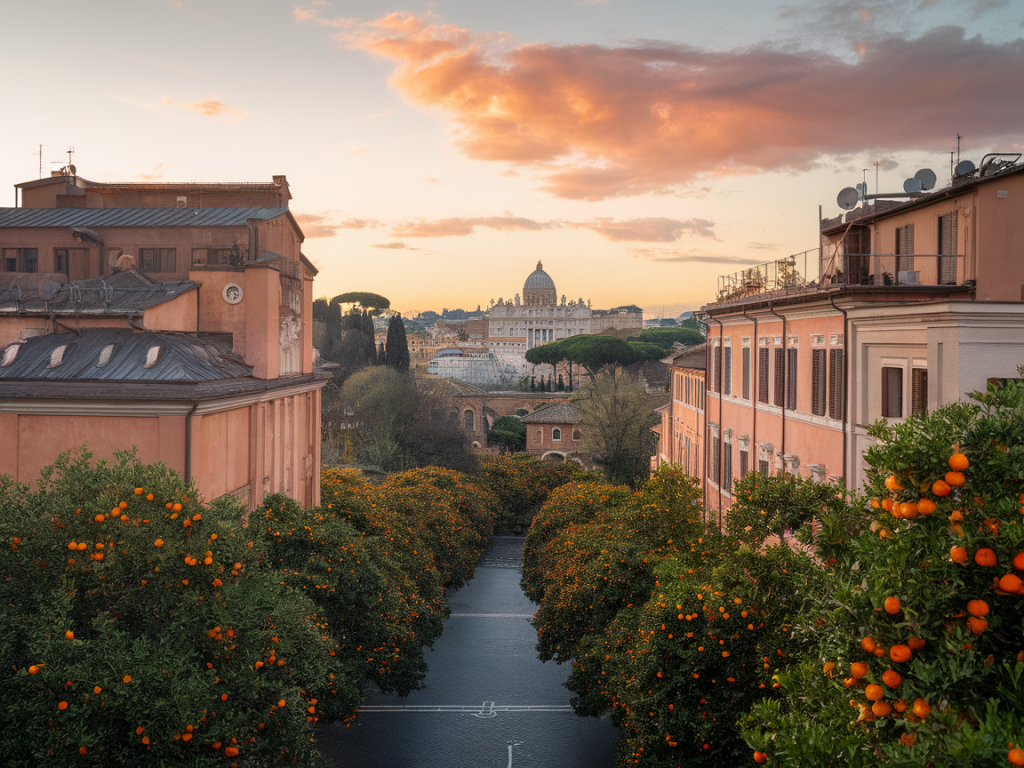
I wake before the city stirs. There’s a particular silence on Rome’s Aventine Hill at dawn — the kind that lets you hear your own footsteps and the distant tram, and notice small details that get lost once buses and tour groups arrive. If you want photographs of orange groves bathed in pink light, the famous Knights of Malta keyhole aligned perfectly with St. Peter’s dome, and the kind of empty piazzas that feel like film sets, this is how I plan a sunrise photo walk that maximizes light, minimizes hassle and leaves room for serendipity.
Why Aventine at sunrise?
Aventine is compact, walkable and layered with quiet scenes: citrus trees in private gardens, crenelated walls, pillowy cypress silhouettes, and a handful of viewpoints that give you that postcard Rome without the crowds. At sunrise the eastern sky colors the oranges and tufa stone in a way that feels almost tactile. You get both wide urban panoramas and intimate still lifes — a street vendor’s shutter, dew on Roman mortar, or a cat sliding through an iron gate.
When to go (timing and seasons)
Check the sunrise time for the day you'll shoot; I use the Photopills app or simply Google "sunrise Rome" to pin it down. Aim to arrive 30–45 minutes before sunrise. This gives you blue hour opportunities (soft, even light), then the warm sweep of golden hour after the sun clears the horizon. In summer I go earlier because the sun rises sooner; in winter the light is lower and richer for longer.
Seasons matter: late winter and early spring bring cleaner air and often the most luminous sunrises. Citrus blossoms (and their scent) appear later in spring — if you want blossom shots, time your trip for April–May. For oranges heavy on the branches, late autumn into winter is best.
How I prepare (gear, clothing, and apps)
- Camera: I shoot with a compact mirrorless body and keep a small travel prime (35mm or 40mm) and a wide zoom (16–35mm) in my bag. The 35mm is perfect for candid street moments and the orange groves; the wide is for piazza panoramas and the sweeping view from the Orange Garden (Giardino degli Aranci).
- Tripod: A lightweight travel tripod is optional but useful for low-light long exposures during blue hour — I bring a carbon-fiber mini that folds small.
- Filters & extras: A small ND or polarizer can help with reflections and skies; extra batteries and an SD card are non-negotiable.
- Clothing: Layer up. Mornings on the hill can be damp and cool even in summer. Comfortable shoes for cobbles and a lightweight windbreaker are my go-tos.
- Apps & maps: Photopills or Sun Surveyor for sun angle, Google Maps for routing, and Citymapper or the ATAC app for public transport times. I also save a small offline map screenshot in case of flaky data.
Route — my favorite loop
I usually make a simple loop that begins at Circo Massimo metro or Piramide (depending where I’m staying) and walks up to Aventine via Lungotevere streets to catch the early light over the Tiber before climbing the hill. Here’s the order I follow:
- Arrive near the Orange Garden (Giardino degli Aranci) — this gives panoramic shots across the city.
- Stroll to the keyhole of the Priory of the Knights of Malta (Buco di Roma) — arrive early to avoid the small crowd that gathers later.
- Wander the lanes — Via di Santa Sabina and surrounding alleys — for citrus-tree still lifes and empty doorways.
- Finish at one of the small piazzas (Piazza dei Cavalieri di Malta or Piazza della Rovere) to capture morning light on façades and market shutters opening.
Key locations and what I look for
Giardino degli Aranci (Orange Garden) — Arriving before sunrise here lets you frame the orange trees with Rome’s skyline beyond. I like a mix of wide pano shots that place the trees against the city, and tighter frames that isolate the saturated fruit against the soft sky.
Keyhole of the Knights of Malta — This is a must. The keyhole aligns perfectly to a framed view of St. Peter’s Basilica. To get a clean image, I crouch low, use a mid-wide focal length and wait for people to clear the viewing spot. The light before and just after sunrise softens the dome and avoids harsh contrast.
Via di Santa Sabina and neighboring lanes — The trees, modest gardens, and private gates are where you’ll find texture: sun on terracotta, dew on oranges, and the interplay of shadow and brick. I look for leading lines — a fence, a row of planters — to draw the eye toward a bright fruit cluster or an open gate.
Piazza shots — Empty piazzas are cinematic at dawn. Use a wide lens and a low angle to emphasize space. If there’s a bench, a parked scooter, or a solitary vendor cart, they make excellent foreground interest.
Composition and camera settings I use
- Blue hour/low light: Handheld at higher ISO with stabilizing shutter speed (1/60–1/160) for candids, or tripod with long exposures (several seconds) for silky skies.
- Golden hour: Lower ISO (100–400), aperture f/5.6–f/8 for depth and sharpness on landscapes, and spot metering for bright skies to protect highlights.
- Keyhole shots: Mid aperture f/4–f/8 depending on lens, single-point AF on the distant dome, and a smaller aperture if you want both keyhole texture and skyline sharp.
- Street details: Shoot wider than you think then move in for details — oranges, gate hardware, moss on stone. I favor 35mm for environmental details that still feel intimate.
Dealing with crowds, access and etiquette
Aventine is generally calm at sunrise, but the keyhole draws curiosity. Be patient and polite; locals value the quiet here. Don’t climb private walls or linger in private gardens without permission. If you’d like closer access to specific courtyards, sometimes a friendly “buongiorno” and asking the gatekeeper can work wonders — I’ve been invited into a small lemon grove before by being respectful and clear about my intent.
Practical tips: transport, coffee, and safety
- Transport: Take the metro to Circo Massimo (Line B) or Piramide for easy access. From there the hill is a 10–20 minute uphill walk depending on route. Taxis and scooters are options but can be slower in the narrow lanes.
- Coffee: There are few cafés open at the first light. I usually bring a thermos or grab an espresso from a bar I find on the way down — the reward of a hot caffè after a long blue hour is one of my favorite rituals.
- Safety: Keep your kit close and minimal. Aventine’s atmosphere is safe, but cobbles and low light require attention. Use a wrist strap and a discreet bag; I prefer a sling bag that keeps my camera on my chest.
Finishing the walk and next steps
After the best of the light passes, I linger over a leisurely espresso or head to a nearby market for breakfast — both ways the morning feels like it stretches. If you’re editing on the go, I use a lightweight laptop or my phone with Lightroom Mobile to cull shots and keep the day’s story intact.
Planning a sunrise photo walk on Aventine is as much about rhythm as it is about shots: arrive early, move slowly, honor the quiet, and let the hill give you both grand views and small, luminous details. If you want a custom map of my exact route, camera settings for specific light conditions, or a suggested gear list for travel-friendly setups, I can put one together for Acidadventure readers.