I slip into the Casbah of Algiers like you might step into a long conversation—quiet, curious and ready to be surprised. Two hours is a tight window, but it’s perfect for a sensory walk that favors rhythm over checklist: taste one thing well, listen closely to the neighborhood’s cadence, and make images that hold the small textures of daily life. Below I map a two-hour loop you can follow without a guide, with practical notes on where to eat, how to behave, and how to shoot the place with a compact mirrorless camera.
Why two hours?
Two hours gives you time to slow down enough to notice—sights, smells, sounds—without losing focus or getting exhausted by the steep lanes. It’s long enough for a few short stops, a proper snack and a handful of frames. The Casbah’s lanes are compact and dense; moving slowly rewards you with repeated discoveries.
Start point and basic logistics
I usually start at the Bab El Oued edge of the Casbah, near the lower slope where the modern city spills into the old medina. It’s easy to reach by taxi or tram. If you’re coming from downtown, ask the driver for the “Casbah Bab El Oued” drop-off—most will know.
What to carry: a compact mirrorless camera (I use a small APS-C or full-frame compact body), a 24–50mm equivalent lens for flexibility, one spare battery, a small crossbody bag, a bottle of water, and a lightweight scarf to cover shoulders if needed. Keep valuables minimal and discreet.
Two-hour loop (timed guide)
Below is the route I follow; the table gives a quick timing you can adapt depending on light and appetite.
| Time | Stop | What to do |
|---|---|---|
| 0:00–0:10 | Entrance alley | Listen for vendors, photograph textures |
| 0:10–0:30 | Market lane (souk) | Taste street snack, interact with sellers |
| 0:30–1:00 | Residential stairways | Portraits of doorways, light & shadow |
| 1:00–1:20 | Terrace viewpoint | Listen to the city, skyline photos |
| 1:20–1:50 | Hidden café or tea spot | Eat, rest, street people-watching |
| 1:50–2:00 | Exit and wrap-up | Last frames, short walk out |
Entry: attune before you shoot
On the first ten minutes I don’t take many photos. I let the Casbah talk first: the rhythm of footsteps on worn stone, the calls of bakers and butchers, the smell of frying and spices. Find a quiet alcove or a low step and breathe. Tune your camera settings for contrasty light—Casbah alleys throw deep shadows and bright highlights. I usually start at ISO 200, a relatively wide aperture (f/4–f/5.6) and shoot handheld at shutter speeds above 1/100s to freeze people moving through the frame.
Market lane: what to eat and how to behave
Markets are the most immediate way to taste a place. I look for a vendor with a small queue; that’s a signal of quality. In the Casbah, try:
- Makroud or other semolina sweets if you want something portable and not too sweet.
- Fresh brik (a thin pastry filled with egg, tuna or meat)—best eaten hot and folded in paper.
- Fresh oranges or dates for a quick, refreshing bite between lanes.
How to order: a smile and a few Arabic phrases go far—“s’il vous plaît” and “merci” work too. Accept offers to taste a sample; vendors often take pride in their goods. Pay attention to hygiene: choose stalls where food is cooked or handled visibly and served hot.
Shooting the market: ethics and technique
Always ask before photographing someone up close. A raised hand and a quick “Oui?” or “Photo?” works. If someone declines, turn to detail shots: hands arranging spices, the curve of a panier, or the texture of charred bread. Use a 35–50mm equivalent for natural perspective; a 24mm can exaggerate and distract in tight lanes.
Residential stairways and textures
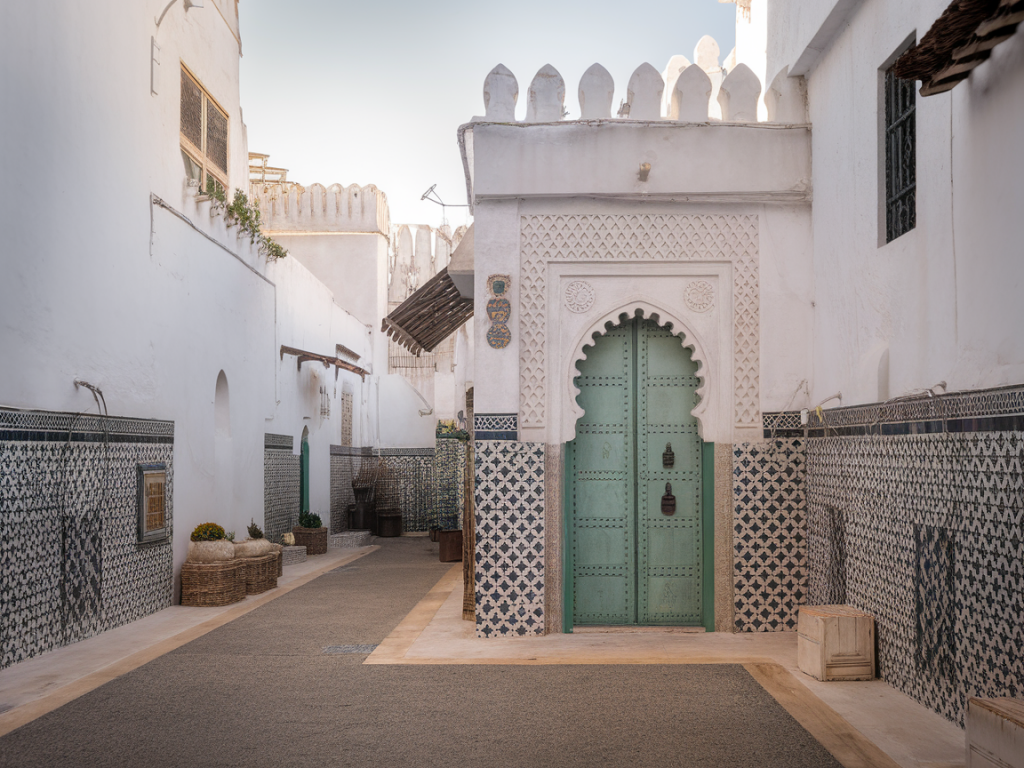
As you move upward, the Casbah’s stairways reveal domestic life: laundry lines, old tiles, worn doors. These are the pictures that age well. I look for repeating patterns: peeling paint frames, shadow bands on steps, a pair of shoes left beside a doorway. For portraits of doors or architectural details, step back, let the subject exist within its context, and shoot with the light on one side to reveal texture.
Find a terrace: listen to the city
About an hour in, I make a small climb to a terrace or high viewpoint. The Casbah opens toward the sea; you’ll hear gulls, the distant traffic of the port and neighborhood conversation layered beneath the city hum. This is a moment to place a wide-frame shot—an image that contrasts the close-up textures of alleys with the expanse of Algiers’ bay. Use a narrower aperture (f/8–f/11) if you want everything sharp from foreground to skyline.
Café stop: tea, talk, and people-watching
Find a small local cafe for mint tea or a coffee. I avoid tourist-facing terraces and pick a place with local customers. Order a mint tea or a small espresso and spend twenty minutes watching how the neighborhood moves. This is where you’ll collect sound—a vendor calling, the cadence of a neighbor’s greeting—that will later inform captions and memories.
What to order: mint tea (served sweet and aromatic) or a small glass of strong coffee. If a plate of olives or nuts is offered, accept; food often opens conversation.
Safety and etiquette
- Dress modestly: a light scarf and conservative clothing help you blend in and show respect.
- Keep your camera strap across your body and your bag in front of you in crowded lanes.
- If a resident asks you not to photograph them, respect that immediately; people’s comfort matters more than any shot.
- Learn a few local phrases: “Salam” (hello) and “Shukran” (thank you in Arabic) or use French—most locals speak it.
Photo aesthetics and quick settings
I prefer natural light and texture. In shade-heavy alleys, boost exposure compensation slightly (+0.3 to +0.7 EV) to bring out shadow detail while preserving highlights. Shoot RAW if you can—those narrow dynamic ranges in alleys benefit from shadow recovery. For portraits, set your lens wide open (f/1.8–f/2.8 if available) to isolate subjects from busy backgrounds.
Leaving the Casbah
As your two hours wind down, choose an exit that brings you toward the waterfront or a tram stop. Walk slowly for the last five minutes and take one or two images that feel like a seal: a hand on a doorway, light on a wall, a tea glass catching the sun. That small, quiet ritual helps you hold the neighborhood with you when you return to the modern city beyond the gates.
If you want a version of this loop that’s photo-first, or one that focuses on family-run food spots, I can sketch alternate routes. For now, let the Casbah decide what it wants to show you—if you pay attention, it never disappoints.