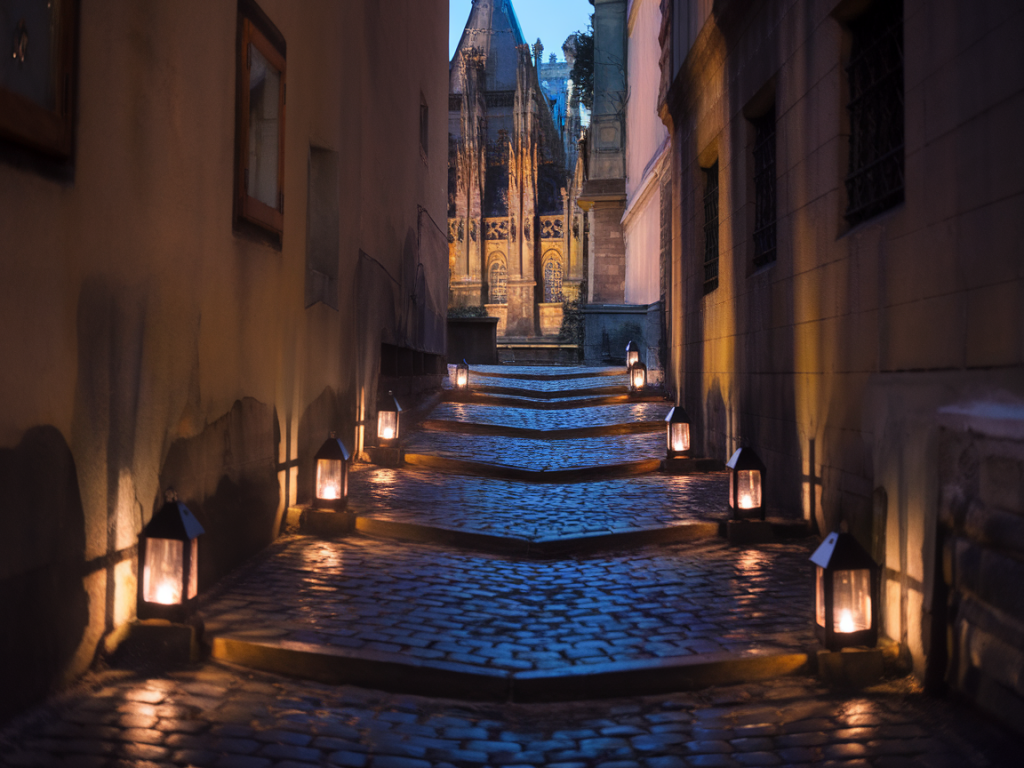
I always travel with a compact mirrorless camera and a small tripod, and Prague after dark is one of those cities that rewards patience and a light kit. The old town's lanterns, the lacquered cobbles of hidden alleys, and the sudden emptiness of public squares just after the last tour bus leaves—all of it turns familiar streets into theatre. Below I share what I look for when photographing Prague after sunset: the moments, the gear, the settings and the little habits that let you capture alleyway light and the quiet drama of empty squares.
What I’m hunting for at night
My frame is usually after the bustle subsides. I’m not photographing tourists so much as the city’s softer personality—the way streetlamps pool into puddles, the hunch of an old doorway, a bicycle shadowed by a cafe's closing sign. Look for:
Pools of artificial light—lanterns and shop windows that create islands in darkness.Wet cobbles and reflections—they add texture and act as natural reflectors.Architectural silhouettes—arches, spires and rooftops that read well against a deep evening sky.Negative space in squares—an empty bench, a single street-cleaner, or the geometry of paving stones.Color contrasts—warm sodium lamps versus cool neon from convenience stores or trams.Best neighbourhoods and exact corners to try
Prague is a compact backdrop, but some spots deliver consistently after dark:
Old Town (Staré Město)—avoid the center of Old Town Square at prime tourist hours; instead wait until after midnight for that classic empty-square shot with the Astronomical Clock lit and the spire silhouettes behind it.Jewish Quarter (Josefov)—narrow streets here have modern lamps that create cinematic pathways; the quiet alleys by Maiselova are great for low-key portraits.Lesser Town (Malá Strana)—walk down from Prague Castle via Nerudova Street into Golden Lane; the tiny houses and uneven stones make intimate compositions.Kampa and Charles Bridge ends—Charles Bridge can be packed until late, but the little courtyards around Kampa Island are often empty and have soft, directional light from riverside lamps.Powder Tower and Celetná—look for the dramatic vertical textures of masonry lit from below.Vyšehrad—for sweeping empty squares with views of the city lights in the distance.Gear I always pack
My kit is intentionally light so I can move fast and stay out late without fatigue:
Compact mirrorless body—Sony A7 series or Fujifilm X-T series are my usual picks for their low-light capability and size.Zoom prime combo—a 24–70mm for flexibility and a 35mm or 50mm prime for low-light sharpness and wider apertures.Small travel tripod—job one for long exposures; I use a Peak Design Travel Tripod because it folds small and is stable on cobbles.Fast lens—a 35mm f/1.4 or 50mm f/1.8 is great for hand-held, low-light alleyway portraits.Spare batteries and a micro-fiber cloth—cold nights drain batteries faster; keep cloth handy for mist on your lens.Settings that work for alleyway light and empty squares
I usually balance tripod long exposures for still scenes with handheld frames to catch passing trams or a person crossing a square. Here’s a quick reference I use in the field:
| Scenario | Tripod | Handheld |
|---|
| Empty square at midnight | ISO 100–400, f/8, 6–30s (to smooth people and capture lamp glow) | ISO 1600–3200, f/2.8–4, 1/30–1/60s |
| Narrow alley with pool of light | ISO 100–800, f/5.6–8, 1–10s | ISO 800–3200, f/1.4–2.8, 1/60–1/125s |
| Tram light trails | ISO 100, f/11, 1–10s (pan or stationary) | ISO 800, f/2.8, 1/30s (freeze a tram) |
Use the tripod to control blooming haloes around lamps and to retain the texture of cobbles. I often bracket exposures—one for the highlights of the lamps, one for the shadows—especially in Old Town where contrast can be brutal.
Compositional tricks I use
Small adjustments make a big difference at night:
Frame with doorways and archways—they create natural vignettes and lead the eye into pools of light.Use reflections deliberately—position yourself low to include puddles; a single lamp reflected can act as a compositional anchor.Include motion as a compositional element—a blurred tram or a cyclist becomes a diagonal that breaks static geometry.Wait for human punctuation—a lone figure walking across an empty square gives scale and story, but capture them as a silhouette to keep the scene timeless.Practical night-walking tips and etiquette
Photographing at night calls for sensitivity and safety:
Be aware of local curfew-like restrictions—most parts of Prague are safe but avoid secluded areas after very late hours.Ask if you're photographing people up close—Prague locals are usually friendly, but a quick “mohu fotit?” (may I take a photo?) in Czech or simple English opens doors.Respect residential spaces—don’t stand on doorsteps or in private courtyards once businesses close.Carry a small headlamp with a red filter to change settings without flooding the scene with bright light.Post-processing notes I use to retain mood
I keep edits minimal and mood-driven rather than obvious. My workflow:
Recover highlights from lamps sparingly—some bloom is atmospheric.Lift shadows just enough to reveal cobble texture while preserving contrast.Adjust white balance—Prague at night can swing orange; cooling the WB slightly or splitting tones (warm highlights, cool shadows) can enhance depth.Sharpen mids and clarity selectively—too much makes cobbles look artificial.If you want a photo-walk map of these spots or a compact route to practice these techniques over a single evening, tell me the neighbourhood you’ll be staying in and I’ll sketch a walk that hits the best light in sequence. Prague after dark is generous to slow wanderers; the streets reward the ones who linger.